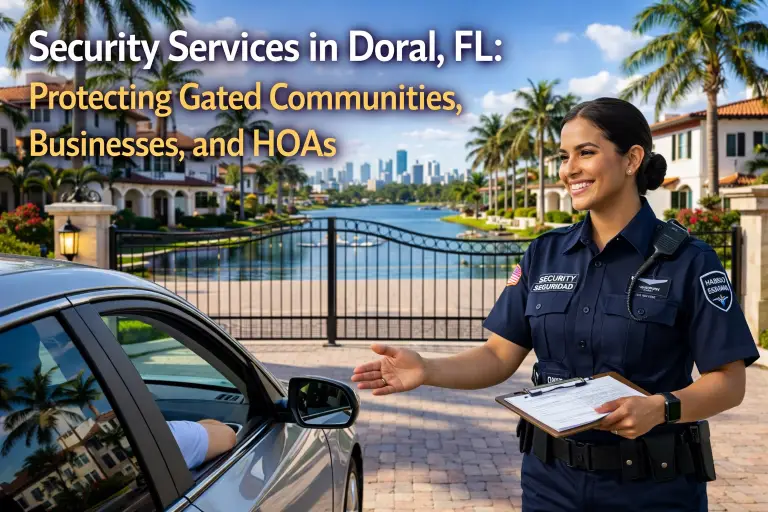
Florida is the most HOA-dense state in the country. With 45% of all homes — approximately 3.9 million households — governed by a homeowners or condominium association, the state leads the nation in HOA prevalence. In Miami-Dade and Broward County alone, thousands of communities operate under HOA governance, ranging from master-planned gated developments in Doral and Weston to high-rise condo associations along the coast.
For the boards that govern these communities, security is one of the most consequential decisions they make. It affects property values, resident satisfaction, insurance exposure, and — increasingly, under Florida’s evolving legal framework — the board’s own liability.
This guide covers everything an HOA board in Miami-Dade or Broward County needs to understand about security: what Florida law requires, what effective security looks like in practice, how to select and manage a security vendor, and what it costs.
Why HOA Security Is a Board-Level Responsibility
The Duty of Care Under Florida Law
Florida law does not mandate a specific level of security for every HOA. But it does impose a duty of care on associations to take reasonable measures to keep common areas safe. Under Florida courts’ interpretation, “reasonable” is measured against what residents could reasonably expect based on the nature of the community itself.
This creates an important dynamic: a gated community with a guard house is held to a higher standard than an open neighborhood with no perimeter controls. Once your HOA establishes security measures — a guard station, perimeter cameras, an access control system — you are expected to operate those measures competently and consistently. A sleeping guard, an unmanned gate, or a broken camera that was never repaired can create liability that would not have existed had the HOA done nothing at all.
As South Florida HOA attorneys have noted, the best way to manage this exposure is to act proactively — working with licensed security professionals, maintaining documented protocols, and never making representations to residents that the association guarantees their personal safety.
What Florida’s 2025 HOA and Condo Laws Add
Florida’s 2025 legislative reforms — particularly House Bill 913 governing condominium associations — significantly raised the bar for board accountability across virtually every operational domain. While the security-specific provisions are indirect, the broader governance changes have clear implications for how boards manage their security vendors:
Vendor credential verification is now a documented board obligation. The same due diligence standards that apply to community association managers now set the tone for all vendor relationships, including security companies. Boards that hire an unlicensed or underinsured security company face governance risk under the transparency and accountability framework the 2025 laws established.
Website and records disclosure requirements mean your security program is visible. Associations with 100+ units must now maintain websites with governing documents, financial reports, and meeting minutes accessible to all members. Security contracts, assessments, and any incident-related expenditures are part of that record.
Board member liability exposure is higher. The 2025 laws strengthened fiduciary accountability. Board decisions about security — including the decision not to invest in adequate security after documented incidents — carry greater weight than before.
The Four Types of HOA Security Programs in South Florida
Not every community needs the same level of security. Understanding the spectrum helps boards build programs that match their community’s profile and budget.
1. Entry Gate and Access Control Only
The most basic tier for gated communities: a controlled entry point with either a manned gate station, an automated access system, or both. This approach deters opportunistic access but provides limited protection within the community once an unauthorized person is inside.
Best for: Smaller HOAs with manageable access points, lower-density communities, or as a baseline layer in a broader security plan.
Limitation: Gate access is only as effective as its consistency. An unstaffed gate that is frequently left open, or a gate code that is widely shared and rarely changed, provides minimal real security.
2. Roving Patrol
A licensed security guard conducts documented patrols throughout the community — parking areas, common spaces, perimeter, pool and amenity areas — on a defined schedule. Patrols are logged and submitted to management.
Best for: Mid-size to large HOAs that need visible deterrence across a wide footprint without the cost of multiple fixed posts. Particularly effective for communities with extensive common areas, parking structures, or history of property crime.
Key requirement: Patrol logs must be maintained for every shift. Patrols without documentation provide no legal protection and little operational value.
3. Stationary Guard at Entry and Key Posts
One or more guards are stationed at specific locations — a lobby, a gate, a pool entrance — during defined hours. Guards manage visitor registration, verify credentials, monitor CCTV feeds, and serve as the first point of contact for resident concerns.
Best for: Medium to large communities with high visitor volume, luxury residential buildings, or HOAs where resident expectations require a visible security presence at all times.
Important: A stationary guard is not a substitute for patrol. Common areas beyond the guard’s line of sight — parking decks, back gates, remote amenity areas — still require periodic patrol coverage.
4. Integrated Full-Coverage Program
A combination of stationary guards, roving patrols, and CCTV monitoring deployed across all shifts, seven days per week. Management receives daily shift reports and incident logs. A dedicated account manager is available to the board for operational concerns.
Best for: Large master-planned communities, luxury high-rises, gated communities with extensive common areas, or any HOA with a documented history of security incidents.
How to Choose an HOA Security Company in Miami-Dade & Broward
The Miami-Dade and Broward security market is large and competitive, with providers ranging from fully compliant professional agencies to unlicensed operators who underbid legitimate companies and create significant liability for the associations that hire them.
Here is the evaluation framework every board should apply:
Florida Licensure — Non-Negotiable
Every security agency operating in Florida must hold a Class B or Class BB security agency license issued by the Florida Department of Agriculture and Consumer Services (FDACS). Individual guards must hold a Class D (unarmed) or Class G (armed) license. Before signing any contract, verify the company’s license number directly at the FDACS online portal.
A company without a valid Florida license is operating illegally. Any incident involving an unlicensed guard or agency creates direct liability for the HOA that hired them.
Insurance — Two Certificates Required
Request a certificate of insurance showing:
– General liability insurance — minimum $1 million per occurrence recommended for community security
– Workers’ compensation insurance — this is the critical one; if a guard is injured on your property and the company does not carry workers’ comp, your HOA’s insurance may be the next line of defense
Ask to be listed as an additional insured on the liability policy. Request updated certificates annually.
References from Comparable HOA Communities
Ask specifically for references from HOA communities similar to yours — comparable size, community type (gated single-family vs. high-rise condo vs. townhome), and in Miami-Dade or Broward County. A company with strong commercial security experience but no residential HOA references is not the same as one that has managed community environments for years.
Call the references. Ask how responsive the company is when issues arise, whether guards show up consistently and on time, and how incident documentation is handled.
Post Orders and Documented Protocols
Before guards arrive at your community, the security company should provide written post orders — a detailed document specifying exactly what each guard is expected to do during their shift, in what order, at what times, and how to handle specific situations.
Post orders are the difference between a guard who knows their job and a guard who improvises. They are also your documentation in the event of a legal dispute about what guards were instructed to do.
Incident Reporting Standards
Request sample incident reports before signing a contract. Every incident — from a minor parking dispute to a serious safety event — should be documented in a written report submitted to management within 24 hours of the occurrence.
Incident reports are your board’s protection. They demonstrate that security personnel were present, that they responded appropriately, and that the board had notice of any recurring issues. Without them, you have no record.
Management Responsiveness
The security account manager assigned to your community should be reachable by phone or text and should respond to operational concerns same-day. Large national security corporations sometimes provide excellent initial pricing but assign overextended account managers who are unavailable when issues arise. South Florida’s HOA market rewards local providers with genuine operational presence and accessible management.
Common HOA Security Mistakes — and How to Avoid Them
Hiring Based on Price Alone
The cheapest security quote in South Florida’s competitive market almost always reflects one of three problems: unlicensed guards, missing insurance, or shared coverage where a single guard is simultaneously responsible for multiple properties. Any of these creates liability that far exceeds the savings on the contract.
Price matters. But the correct comparison is between licensed, insured providers — not between compliant providers and those who cut compliance costs to undercut legitimate competitors.
Making Safety Promises to Residents
Florida HOA attorneys consistently advise boards to avoid any language — in newsletters, meeting minutes, or verbal communications — that could be interpreted as a promise to keep residents safe. Statements like “our security team ensures the safety of all residents” create a standard the HOA cannot guarantee and may be held to in litigation.
Security communications should describe what measures are in place, not make guarantees about outcomes.
Neglecting Off-Peak Hours
Boards often invest in daytime or evening security coverage and reduce or eliminate overnight and weekend staffing to manage costs. The result is predictable: incidents cluster during uncovered hours. A strong security program builds coverage around the community’s actual risk pattern — which in most South Florida communities peaks on weekend nights and during the off-season when units are unoccupied.
Ignoring Patrol Documentation
A guard who patrols without logging is providing less protection than a documented patrol program — both in terms of deterrence and legal defensibility. If a resident claims they reported a safety concern that was never addressed, and you have no patrol logs showing what areas were covered or when, the board has no evidence of due diligence.
Failing to Verify Vendor Credentials Annually
Security agencies must renew their licenses. Individual guards must maintain current Class D or Class G licenses. Insurance certificates expire. A security company that was fully compliant when you signed the contract two years ago may have lapses in licensing or coverage today. Build annual credential verification into your board’s vendor management calendar.
Budgeting for HOA Security in Miami-Dade and Broward
Security is a line item in every HOA operating budget. Understanding realistic cost ranges helps boards plan accurately and communicate with residents.
Typical HOA Security Budget Ranges (2025)
| Program Type | Estimated Monthly Cost | Notes |
|---|---|---|
| Part-time gate guard (40 hrs/week) | $3,500 – $5,500 | Daytime coverage only |
| Full-time gate/lobby guard (168 hrs/week) | $12,000 – $20,000 | 24/7 single post |
| Roving patrol (one guard, 8-hr shifts) | $4,000 – $7,500 | 5–7 days/week |
| Integrated program (gate + patrol) | $18,000 – $35,000+ | Larger communities |
These figures reflect rates from licensed, insured security agencies in Miami-Dade and Broward County. Costs vary based on hours, guard qualifications, number of guards required, and whether management oversight is included.
Presenting Security Costs to Residents
Many HOA boards struggle to build resident support for security budget increases. The most effective approach frames security cost in terms of what it protects: property values, insurance premiums, and the community’s reputation as a desirable place to live. In Doral and other high-demand Broward and Miami-Dade communities, the presence of active HOA security is a documented factor in real estate premium pricing.
A board that can show residents that documented, professional security reduced incidents — with specific incident log data — builds consensus for ongoing investment more effectively than abstract appeals to safety.
How Truman Security Partners with HOA Boards
Truman Security has served homeowners associations and condominium communities across Miami-Dade and Broward County since 2014. We understand the specific operational environment of South Florida’s HOA market — the seasonal population swings, the mix of full-time residents and absentee owners, the contractor access complexity created by Florida’s 2025 inspection requirements, and the resident relations dynamic that requires guards to be professional, courteous, and firmly consistent simultaneously.
Every Truman Security HOA engagement includes:
- Written post orders customized to your community’s layout and specific requirements
- Daily shift reports and incident logs delivered to your property manager or board contact
- Florida-licensed, background-checked guards — we provide license numbers upon request
- Certificate of insurance naming your association as additional insured
- A dedicated account manager reachable by phone for operational issues
- Flexible contract terms that accommodate seasonal coverage adjustments
We work with boards through the proposal process — site assessments, written scope of service, and transparent pricing — so that you have everything needed to present an informed vendor decision to your membership.
Frequently Asked Questions for HOA Boards
Can our HOA be sued if a crime occurs in a common area?
Yes, under certain circumstances. Florida courts evaluate whether the HOA took reasonable measures to address foreseeable risks. If your association had prior notice of safety incidents in a common area and took no responsive action, that creates exposure. Documenting your security program, responding to reported concerns, and working with licensed professionals are the core elements of defensible due diligence. Consult your HOA attorney for guidance specific to your governing documents and claim history.
Should our HOA hire guards directly or through a security agency?
Hiring through a licensed security agency is almost universally the better approach for HOAs. Direct employment means the HOA takes on all employer obligations: payroll taxes, workers’ compensation, training, background checks, scheduling, and coverage for absences. Agencies handle all of these while providing the HOA with a single contract point and documented accountability. The HOA should still verify the agency’s license and insurance — but the operational complexity is substantially reduced.
Do our guards need to be armed?
For the vast majority of HOA communities in Miami-Dade and Broward County, unarmed security is both appropriate and effective. Unarmed guards provide strong deterrence through visible presence and consistent patrol. Armed guards carry additional liability for the association and require specific situations — high-value assets at risk, documented elevated threat levels — to be justifiable. Discuss this with your HOA attorney and your security provider based on your specific community profile.
How do we handle a guard who is not performing?
Your security contract should include a performance clause that allows the HOA to request guard reassignment if a specific guard is not meeting the post order requirements. A reputable security agency will respond to documented, specific performance concerns quickly — this is why incident logs and patrol records matter. If an agency is consistently unresponsive to documented performance issues, that is grounds for contract termination with proper notice.
How often should our board review the security program?
At minimum, annually. A formal security review — looking at incident trends, patrol coverage, resident complaints, and vendor compliance — should be part of every HOA board’s annual planning process. After any significant incident, a targeted review should occur regardless of the calendar. Many boards include a security standing committee as part of their governance structure, which allows ongoing monitoring without requiring full board attention every month.
Ready to Build a Stronger HOA Security Program?
Truman Security provides licensed, documented, professionally managed security for HOA communities throughout Miami-Dade and Broward County. We offer free site assessments and written proposals with transparent pricing.
Schedule Your Free HOA Security Assessment
Truman Security · Licensed HOA Security Services · Miami-Dade & Broward County · License No. B1300316 · (305) 400-0989 · Available 24/7